
Choosing new windows is about much more than deciding how they should look.
The right windows can change the character of a room, bring in more natural light, improve ventilation, reduce drafts, increase comfort, and help your home use energy more efficiently. But with so many styles, materials, glass options, energy ratings, and configurations available, knowing what to buy can quickly become overwhelming.
Whether you’re replacing a few aging windows or planning a larger renovation, the best choice depends on how you use each room, your home’s architecture, the direction each window faces, your climate, and your long-term priorities.
This guide explains the most important factors to consider when choosing new windows, so you can compare your options with confidence and select products that make sense for your home.
1. Start With the Purpose of Each Window
Before comparing brands or specifications, think about what you want each window to accomplish.
Not every room needs the same type of window.
A living room may benefit from a large fixed window that maximizes natural light and views. A bedroom may need an operable window for ventilation and, depending on the room, an appropriate emergency-egress configuration. A kitchen may benefit from a window that is easy to operate and clean. A bathroom may need ventilation while also providing privacy.
Ask yourself:
- Do I want more natural light?
- Do I need better ventilation?
- Is the view particularly important?
- Is privacy a concern?
- How easy does the window need to be to operate?
- Will it be difficult to reach for cleaning?
- Is the room exposed to strong sunlight?
- Is the existing window drafty or uncomfortable?
- Am I trying to improve energy efficiency?
- Does the new window need to complement the home’s existing architecture?
Starting with these questions helps narrow the choices before you get into technical specifications.
2. Choose the Right Window Style
Window style affects appearance, ventilation, operation, maintenance, and how you use the space.
There isn’t one universally “best” window style. The right choice depends on the room and your priorities.
Casement Windows
Casement windows are hinged at the side and open outward, typically using a crank mechanism.
Because the sash opens outward, casement windows can provide substantial ventilation and a broad opening when fully opened. Their closing mechanism can also draw the sash firmly against the frame.
Good for:
- Bedrooms
- Living rooms
- Kitchens
- Areas where ventilation is important
- Contemporary and traditional homes
Casement windows can also be an excellent choice when you want a relatively unobstructed view with a clean appearance.
Awning Windows
Awning windows are hinged at the top and open outward from the bottom.
Their design can allow ventilation while helping shield the opening from light rain, making them particularly useful in certain locations around the home.
Good for:
- Bathrooms
- Kitchens
- Basements
- Areas where ventilation is important
- Combining with larger fixed windows
Picture or Fixed Windows
Picture windows do not open. Their primary purpose is to provide views and natural light.
Because they have no operating sash, they can offer a clean appearance and eliminate the need for operating hardware.
Good for:
- Living rooms
- Large feature areas
- Rooms with attractive outdoor views
- Spaces where ventilation is provided by another window
A fixed window can also work particularly well as part of a combination with operable windows.
Single Hung windows
Single hung windows have two vertically arranged sashes, with the bottom sash moving while the upper sash remains fixed.
They provide a traditional appearance and straightforward operation.
Good for:
- Bedrooms
- Living spaces
- Traditional-style homes
- Renovation projects where a classic appearance is preferred
Sliding Windows
Sliding windows operate horizontally, with one or more sashes moving along a track.
They don’t require an outward swing, which can be useful when exterior space is limited.
Good for:
- Wide openings
- Bedrooms
- Basements
- Areas where simple operation is important
Bay and Bow Windows
Bay and bow windows project outward from the home’s exterior wall, creating additional visual dimension and, depending on the configuration, additional usable interior space.
They can dramatically change the appearance of a room while creating a larger viewing area.
Good for:
- Living rooms
- Dining areas
- Feature walls
- Homes where architectural character is important
Custom-Shaped Windows
Sometimes a standard rectangular window simply isn’t the right solution.
Custom-shaped windows can be designed for architectural features, unusual openings, decorative applications, or areas where you want the window itself to become a design element.

3. Think About How the Window Opens
Two windows may look similar but behave very differently.
Consider the direction and amount of ventilation you want, as well as how the window will be accessed.
For example:
- A casement can open widely outward.
- An awning opens from the bottom.
- A slider moves horizontally.
- A single hung window operates vertically.
- A picture window does not open.
Also consider furniture and exterior obstacles.
A window that opens outward may not be ideal if it interferes with a walkway, deck, landscaping, or another structure. Similarly, a large operable window should be easy and comfortable to reach.
The best window isn’t simply the one with the most features—it’s the one that works naturally within the room.
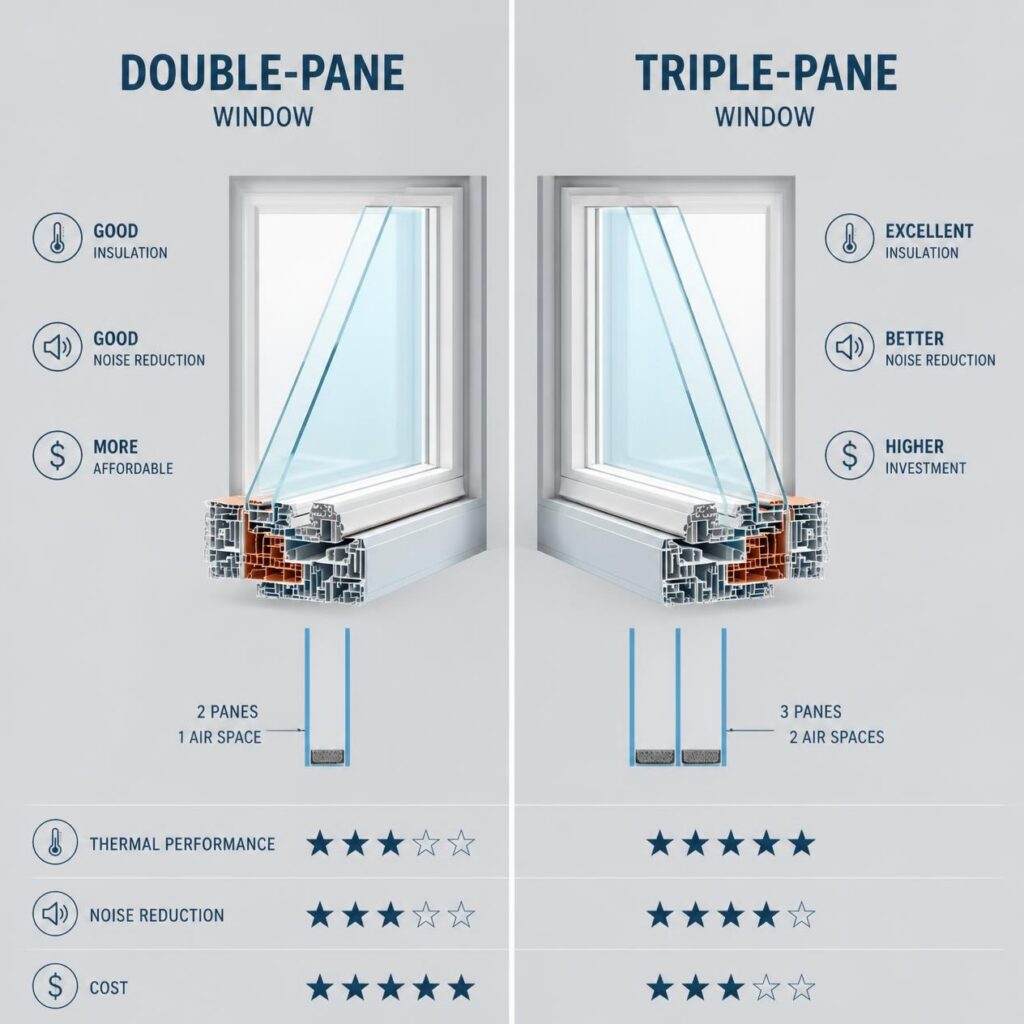
4. Decide Between Double-Pane and Triple-Pane Glass
The glass package is one of the most important decisions you’ll make.
Double-Pane
Double-pane windows have two panes of glass separated by an insulating space.
They can provide a substantial improvement over older, inefficient glazing systems and can be an appropriate choice depending on the home’s design, climate, budget, and performance goals.
Triple-Pane
Triple-pane windows use three panes of glass and two insulating spaces.
The additional layer can improve thermal performance and help create a more comfortable interior surface temperature during cold weather.
For homes in colder Canadian climates, triple-pane glazing can be particularly attractive when maximizing energy efficiency and winter comfort is a priority. The City of Calgary notes that triple-pane windows perform better than double-pane windows at helping keep homes warm in winter and cool in summer.
However, don’t assume that “triple-pane” automatically means “best.”
The overall performance of a window depends on the complete product – including the glass, coatings, spacer, frame, construction, and air leakage – not simply the number of panes.
5. Understand Low-E Glass and Gas Fills
Modern energy-efficient windows can incorporate technologies that improve the performance of the glazing system.
Low-E Glass
Low-emissivity, or Low-E, coatings are extremely thin coatings applied to glass to help control heat transfer and solar radiation.
Depending on the product and application, Low-E coatings can help reduce unwanted heat loss while managing solar heat gain.
The important point is that Low-E glass isn’t simply about “letting less heat through.” Different glazing configurations can be designed for different climates, orientations, and performance goals.
Argon Gas
The space between panes is often filled with an insulating gas such as argon.
Gas-filled insulating glass units can reduce heat transfer compared with an equivalent air-filled cavity.
When comparing windows, therefore, look beyond the number of panes and ask what the complete glazing package includes.
6. Learn the Energy Ratings Before You buy
Window specifications can look complicated at first, but a few key measurements are especially useful.
U-Factor
U-factor measures the rate of heat transfer through the window.
Lower U-factor generally means better insulation and less heat transfer.
This is particularly important in cold climates because reducing heat loss through the window can contribute to improved indoor comfort and energy performance.
Natural Resources Canada identifies U-factor as one of the key Canadian window-performance measurements.
Energy Rating (ER)
Energy Rating, or ER, combines several performance factors, including heat transfer, solar heat gain, and air leakage.
Higher ER indicates better overall energy performance.
ER can therefore be useful when comparing complete window products rather than looking at one measurement in isolation.
Solar Heat Gain Coefficient (SHGC)
SHGC describes how much solar heat enters through the window.
A lower SHGC generally means less solar heat gain.
But lower isn’t automatically better in every situation.
Window orientation matters.
A heavily sun-exposed room may benefit from a different SHGC than a shaded room. Natural Resources Canada specifically recommends considering the window’s location and sun exposure when evaluating SHGC.
Air Leakage
Air leakage measures how much air passes through a closed window assembly.
Lower air leakage generally means a tighter window.
This matters because unwanted air movement can contribute to drafts, discomfort, and energy loss.
Visible Transmittance
Visible Transmittance, or VT, describes how much visible light passes through the glazing.
Higher VT generally means more visible daylight enters the room.
This can be an important consideration when natural light is a major priority.
7. Look for ENERGY STAR Certification
ENERGY STAR certification can provide a useful starting point when comparing energy-efficient windows.
Rather than relying only on marketing language such as “high efficiency” or “energy saving,” look for independently established performance criteria.
Natural Resources Canada recommends verifying that a product is actually certified and checking the current searchable ENERGY STAR product list before purchasing.
Current Canadian ENERGY STAR criteria for residential windows and doors include either a maximum U-factor of 1.22 W/m²K or a minimum ER of 34, along with air-leakage requirements.
However, don’t shop based on certification alone.
A certified window can still have different characteristics from another certified window. Compare the actual performance values and choose the configuration that makes sense for your home.
8. Consider Which Direction the Window Faces
The orientation of a window can affect its ideal performance characteristics.
A large south- or west-facing window may receive substantial solar exposure, while a north-facing window may receive much less direct sunlight.
This affects how you should think about SHGC, glazing, shading, and overall comfort.
For example, a window that receives intense afternoon sun may need different solar-control characteristics from one installed on a shaded side of the house.
This is one reason why choosing every window based on exactly the same specifications isn’t always the best approach.
Think about the room, the orientation, and the amount of glass – not just the product label.
9. Choose the Right Frame Material
The frame is another major component of window performance and appearance.
Vinyl
Vinyl frames are widely used because they can offer good insulation, durability, and relatively low maintenance.
They are available in a wide range of styles and configurations and can work well for both renovations and new construction.
Fiberglass
Fiberglass frames can offer strength, dimensional stability, and durability.
They may be attractive for homeowners looking for a different combination of performance, appearance, and long-term durability.
Wood
Wood offers a traditional, natural appearance and can complement certain architectural styles particularly well.
However, exterior exposure means wood generally requires more maintenance than many modern alternatives.
Composite and Other Materials
Some manufacturers use engineered or composite materials designed to combine particular characteristics of different frame materials.
The important thing is not to choose a material based solely on a generic ranking.
Instead, consider:
- Thermal performance
- Durability
- Maintenance
- Appearance
- Budget
- Warranty
- Compatibility with your home
10. Don’t Ignore the Spacer and Frame Design
It’s easy to focus entirely on the glass, but the window is a complete system.
The frame, sash, seals, spacer system, and glazing all contribute to overall performance.
A highly efficient glass unit does not automatically make the entire window highly efficient.
When comparing products, look at the whole-window performance, not just the centre-of-glass specifications.
This is another reason standardized performance ratings are valuable: they allow you to compare complete products more meaningfully.
11. Consider Comfort, Not Just Energy Bills
Energy efficiency is important, but comfort is one of the biggest reasons homeowners notice the difference between old and new windows.
Poor-performing windows can contribute to:
- Cold areas near the glass
- Drafts
- Uneven room temperatures
- Condensation
- Excessive solar heat
- Uncomfortable seating areas near windows
A well-designed window can help create a more consistent indoor environment.
If a particular room has always felt colder in winter or hotter in summer, think about the underlying cause before choosing a replacement window.
12. Think About Maintenance and Cleaning
A beautiful window isn’t very useful if it’s difficult to live with.
Consider how the window will be cleaned and maintained.
Ask:
- Can both sides of the glass be reached safely?
- Are the operating components easy to use?
- Will the window be exposed to harsh weather?
- Are replacement parts readily available?
- How much maintenance does the frame require?
For upper-floor windows especially, ease of cleaning should be considered before choosing a configuration.
13. Think About Safety and Emergency Egress
Window selection isn’t only about aesthetics and energy performance.
Certain rooms may have specific safety requirements, particularly bedrooms and basement spaces where a window may serve as an emergency escape and rescue opening.
If you’re changing the size or configuration of a window opening, local building requirements may also apply.
The City of Calgary notes that permits may be required for new windows or when enlarging existing window openings.
Before finalizing a configuration, make sure the proposed window meets applicable building and safety requirements for its location.
14. Match the Window to Your Home’s Architecture
Performance matters, but appearance matters too.
Your windows are a major part of your home’s exterior design.
Consider:
- Frame colour
- Interior and exterior finishes
- Grid or grille patterns
- Window proportions
- Glass area
- Hardware
- Trim
- Architectural style
A contemporary home may look best with clean, expansive glass and minimal visual interruption.
A traditional home may benefit from more classic proportions and grille patterns.
The goal isn’t necessarily to make every window identical. The goal is to create a cohesive overall appearance.
15. Don’t Choose Windows Based on Price Alone
Price is obviously important, but the cheapest window isn’t necessarily the best value.
A lower-priced product may have different:
- Energy performance
- Frame construction
- Glass configuration
- Hardware
- Warranty
- Expected durability
- Appearance
Instead of asking only:
“How much does this window cost?”
Ask:
“What am I getting for the price, and how well does it meet my needs?”
A window is a long-term component of your home. Looking at value over its expected lifespan can be more useful than comparing the initial purchase price alone.
16. Ask About the Warranty
Before purchasing, understand exactly what the warranty covers.
Ask about:
- Frame coverage
- Glass coverage
- Hardware
- Seals
- Finish
- Labour, if applicable
- Transferability
- Warranty duration
- Exclusions
- What happens if a component fails
Don’t simply accept “lifetime warranty” as the end of the conversation.
Read the actual warranty terms.
Understanding what is covered and what isn’t – can prevent unpleasant surprises later.
17. Be Careful With Online Window Shopping
Online research is extremely useful for narrowing your options, but window specifications can be difficult to compare without context.
A product may look impressive because it advertises triple-pane glass or a particular energy rating, but the complete specification matters.
When comparing products, look for actual values for:
- U-factor
- ER
- SHGC
- Air leakage
- Glazing layers
- Frame material
- Glass coating
- Gas fill
- Visible transmittance
- Warranty
And make sure you’re comparing like with like.
A triple-pane window with one specification isn’t automatically comparable to another triple-pane window with a different frame, coating, spacer, and performance rating.
18. Get the Measurement Right
Window replacement isn’t simply a matter of ordering a window that looks approximately the same size as the existing one.
The existing opening, frame condition, desired configuration, and replacement approach all need to be considered.
If you’re replacing an existing window, don’t assume that the visible glass size is the required order size.
Measurements can involve the existing frame and opening dimensions, and unusual openings may require custom solutions.
For major replacement projects, accurate measurements should be confirmed before the final product is ordered.
19. Think About the Whole Home
One of the easiest mistakes is choosing windows individually without considering the home as a whole.
You may want:
- More ventilation in bedrooms
- Larger glass areas in living spaces
- Privacy in bathrooms
- Maximum daylight in common areas
- Improved energy performance throughout
- A consistent exterior appearance
That means different rooms may legitimately use different window styles.
A good window plan balances performance, function, aesthetics, and budget across the entire home.
Common Window-Buying Mistakes to Avoid
Choosing only based on appearnace
A beautiful window that doesn’t perform well for your home’s needs may become frustrating over time.
Assuming triple-pane is automatically the best choice
Triple-pane can offer excellent thermal performance, but the complete window specification matters.
Looking at U-factor alone
U-factor is important, but ER, SHGC, air leakage, glazing, and other characteristics also matter.
Ignoring the window’s orientation
The amount of sun a window receives can influence the appropriate glazing and SHGC.
Buying every window in the same configuration
Different rooms have different ventilation, privacy, lighting, and operational requirements.
Focusing only on the initial price
Consider performance, durability, maintenance, warranty, and long-term value.
Forgetting about cleaning
A difficult-to-reach window can become a maintenance headache.
Not checking certification and specification
Don’t rely solely on marketing claims. Look for verified performance information and current certification where applicable.
Final Thoughts: Choose Windows for the Way You Live
The best window isn’t necessarily the most expensive, the largest, or the one with the longest list of features.
It’s the one that fits your home.
Start with the room. Think about ventilation, sunlight, views, privacy, comfort, maintenance, and appearance. Then compare the technical specifications that determine how the window will actually perform.
Pay particular attention to U-factor, ER, SHGC, air leakage, glazing, frame construction, and ENERGY STAR certification. These details can tell you far more about a window’s performance than appearance alone.
Most importantly, look at the complete product rather than judging it by a single specification.
A well-chosen window should do more than fill an opening in your wall. It should bring natural light into your home, support comfortable indoor temperatures, complement your architecture, and perform reliably for years to come.
At NORC Windows & Doors, we believe choosing the right product should feel straightforward—not overwhelming. Explore our range of window styles and find a solution that fits the way you want your home to look, feel, and perform.